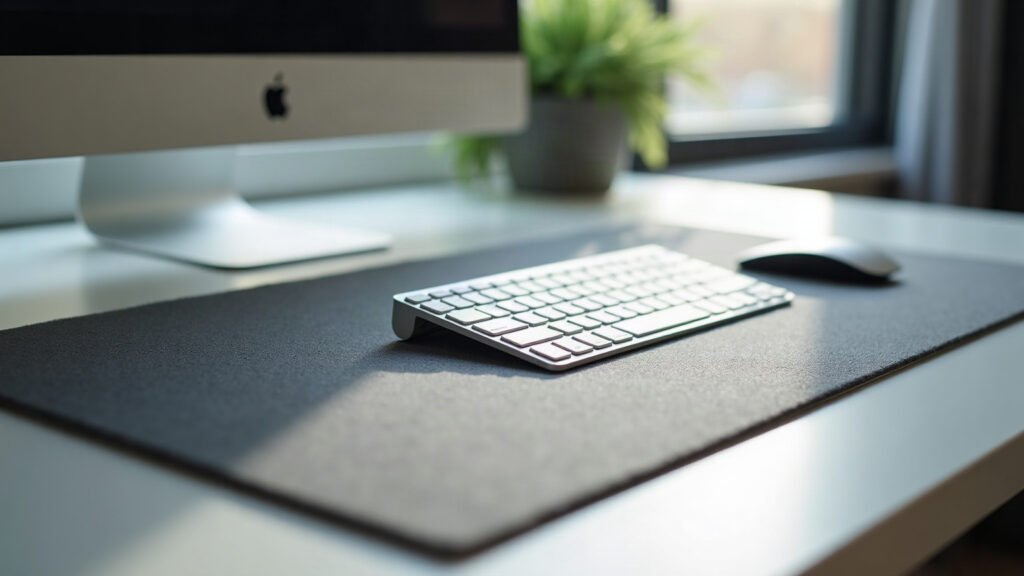
A printed desk mat that peels after three months was made with the wrong printing process. If you can feel the edges of a graphic with your fingernail, or if the surface feels like rubberised plastic on top of fabric, the ink sits as a separate layer on the surface. Friction from your wrist, mouse movement, and routine cleaning will slowly tear that top film away from the backing.
Dye sublimation works differently. Instead of painting a layer onto fabric, it converts solid dye into gas under heat and pressure. The gas embeds directly into the polyester fibres and solidifies inside them. Once dyed, the design cannot crack, peel, or scratch off because it is part of the material itself.
The Chemistry of Sublimation: Solid to Gas
Most common printing methods rely on liquid inks that dry on the surface of a material. Screen printing, direct-to-garment (DTG), and heat transfer vinyl (HTV) all leave a measurable film over the weave. Over time, mechanical abrasion separates that dried film from the flexible threads underneath.
Sublimation bypasses the liquid phase entirely. The term describes a physical phase change where a solid transitions straight into a gas without melting first.
How the Heat Press Changes the Fibres
To print an image, special disperse dyes are first printed in reverse onto high-release transfer paper. The paper is placed face-down on white 100% polyester fabric and loaded into an industrial flatbed heat press.
The press applies two things simultaneously:
- Temperature: Heat between 190 and 205 degrees Celsius (375 to 400 degrees Fahrenheit).
- Pressure: Constant, even pressure across the entire surface area.
At approximately 190 degrees Celsius, two critical physical changes happen at the same instant. First, the solid dye on the transfer paper turns into gas. Second, the polymer chains in the polyester fabric relax, opening microscopic pores in the synthetic fibres. The gaseous dye enters these open pores and permeates the core of each individual strand.
When the press opens and the temperature drops below 180 degrees Celsius, the polyester pores close tightly. The dye returns to a solid state inside the fibre. The colour is locked inside the plastic threads, not sitting on top of them.
Why Sublimation Outlasts Surface Prints
Because the dye sits inside the thread, the physical properties of the fabric do not change. The surface texture remains identical across printed and unprinted areas.
The difference comes down to mechanical wear. When your mouse or forearm moves across a desk mat, friction acts on the top layer of material. On a vinyl or screen-printed mat, friction rubs against the ink film and breaks the adhesive bond between ink and thread. On a sublimated mat, friction rubs against the raw polyester fibres. The colour remains as long as the fibre exists.
| Feature | Dye Sublimation | Heat Transfer Vinyl (HTV) | Screen Printing |
|---|---|---|---|
| Ink Location | Inside the polyester fibres | Glued on top of the fabric | Dried on top of the fabric |
| Surface Feel | Identical to bare fabric | Rubberised and raised | Thick, slightly textured |
| Peeling Risk | Zero (physically impossible) | High after repeated flexing | Medium (cracks over time) |
| Breathability | Completely unblocked weave | Traps air and moisture | Partially blocked weave |
| Resolution | Photo-sharp (300+ DPI) | Vector shapes only | Halftone dots, lower detail |
How to Tell Which Printing Method Was Used
You can identify how a mat or pad was manufactured in less than ten seconds using three basic tests. You do not need specialist tools.
- The Scratch Test: Run your fingernail across the boundary between a dark printed area and a light background. If you feel a distinct ledge or step, the design was applied with vinyl or thick plastisol ink. A sublimated mat feels uniform and smooth across every color transition.
- The Stretch Test: Gently pull the fabric in opposite directions. A surface-printed design will show micro-fissures or white cracks in the ink as the fabric expands underneath. A sublimated design stretches with the fabric without cracking, because the dyed threads simply separate and return to position.
- The Backing Test: Look at the cross-section of the fabric edge or flip the material over. If the colour shows slight bleed into the top half of the weave without any clear plastic film, it was sublimated.
The Technical Limits of Sublimation
Dye sublimation is the most durable print method for synthetic textiles, but it has specific physical constraints. Understanding these limits prevents unrealistic expectations.
It Requires Polyester
Disperse dyes only bond with synthetic polymers like polyester, nylon, and specific acrylic blends. Natural fibres such as cotton, wool, and linen do not have polymer chains that open under heat. If you attempt to sublimate 100% cotton, the gas washes out during the first rinse. High-durability desk mats always use a tightly woven polyester top cloth laminated to a natural rubber base.
It Works Best on Light Bases
Sublimation dyes are transparent rather than opaque. They act like stained glass, not wall paint. Because of this, the process requires a white or light-coloured substrate. When you print black dye on white polyester, the result is deep black. If you try to sublimate white ink onto black fabric, nothing happens because white sublimation ink does not exist. White areas in a design are created by leaving the underlying white polyester unprinted.
UV Sensitivity Over Years
While sublimated prints are impervious to water, sweat, and mechanical friction, disperse dyes can fade over several years if exposed to direct, unfiltered sunlight for eight hours every day. For indoor desk setups, this is rarely an issue, but outdoor gear will eventually show slight colour shift after extended UV exposure.
How to Maintain a Sublimated Surface
Because the ink cannot wash away, cleaning a sublimated mouse pad or desk mat is straightforward. The colour will not run under water.
For routine maintenance:
- Wipe the surface with a damp microfibre cloth to remove dust and skin oils.
- For deeper cleaning, hand-wash the mat in cold or warm water using mild dish soap. Use a soft sponge or cloth to agitate dirt out of the weave.
- Avoid harsh bleach and high-heat drying cycles. While the polyester top can handle heat, extreme heat in a tumble dryer can degrade the natural rubber base underneath. Let the mat air-dry flat away from direct heat sources.
If you use small mouse pads or large full-desk mats, checking that they are dyed via sublimation ensures the surface glides consistently without worn patches or flaking edges.
Production and Our Print Guarantee
Every made-to-order item requires proper heat-press dwell time to ensure complete dye saturation. Our production takes 2 to 5 business days, extending up to 10 days during peak seasonal periods. We ship free across the United States on every order, with flat-rate shipping from $7.95 elsewhere and free worldwide delivery on orders over $99.
We inspect prints for clean transfer lines and full gas penetration. If an item arrives damaged, misprinted, faulty, or is lost in transit, we provide a free replacement or a full refund without requiring a return. Contact us within 30 days of delivery with a clear photograph of the issue.
Specifications come from our suppliers’ published data. Where we link to gear we do not make, those links may earn us a commission at no extra cost to you.

Leave a Reply