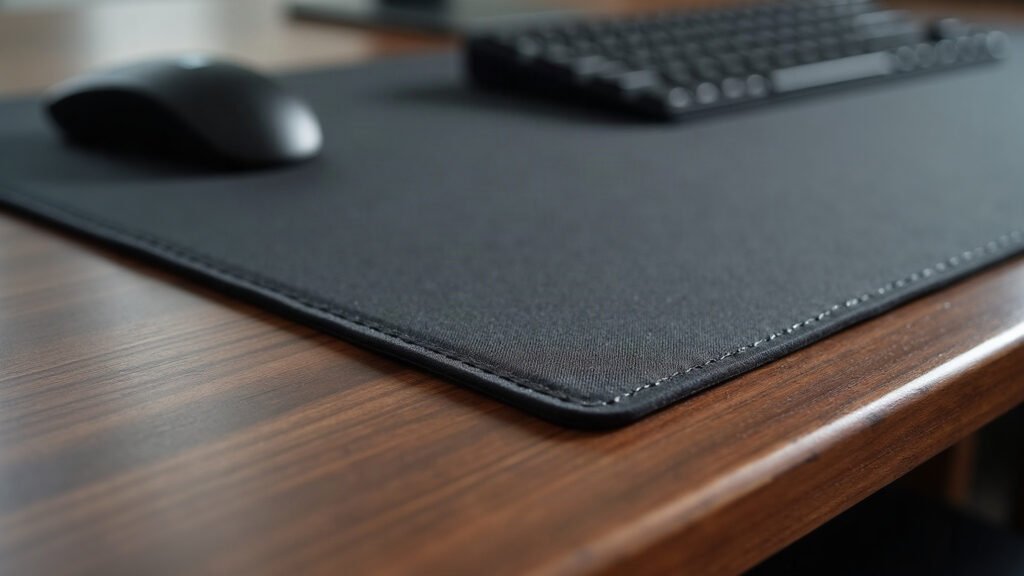
A desk mat almost never wears out in the center first. It fails at the front edge, right where your forearm rests while you type and move your mouse.
That single point of contact creates friction hundreds of times every working hour. Over six months, that friction tests the bond between the printed fabric top and the rubber base underneath. Whether that bond holds depends entirely on how the manufacturer finished the edge.
How Raw Edge Desk Mats Are Made
A raw edge mat begins as a large roll of composite material: a woven polyester fabric laminated directly onto open-cell natural rubber or synthetic foam. A laser or a steel die stamp punches the final rectangular shape out of the roll in one swift motion.
The edge you receive is the exposed cross-section of that laminate. There is no thread, no border, and no physical barrier holding the fabric layer to the rubber core beyond the initial adhesive glue line.
Why Raw Edges Start to Fray
Raw edges look clean out of the box. They sit flat against your desk surface with zero ridge at the perimeter. For the first few weeks, the edge feels seamless under your wrist.
Then sweat, skin oils, and mechanical friction go to work. Every time you shift your arm forward to reach the function keys, your skin catches microscopic fibers on the fabric surface. Skin oils break down the adhesive along the cut line. Within three to six months of daily use, three distinct things happen:
- Micro-fraying: Individual polyester threads pull loose along the perimeter, creating a fuzzy border.
- Delamination: The top fabric lifts away from the rubber base, starting at the bottom left or bottom right where your arms rest.
- Curling: The rubber base stretches slightly under directional arm pressure, causing the corners to lift off the desk.
Once delamination starts on a raw cut edge, you cannot glue it back down neatly. The mat becomes a throwaway item.
How Stitched Hems Prevent Edge Separation
A stitched hem runs an overlock thread pattern around the entire perimeter of the cut mat. A multi-needle industrial sewing machine loops dense thread over the top fabric, through the rubber base, and underneath the bottom grip.
This loop acts as a physical clamp. Even if skin oils weaken the surface adhesive near the border, the fabric cannot peel away from the rubber because thousands of tight thread passes lock both layers together mechanically.
Raised Stitching vs Flush Stitching
Not all stitched edges feel the same under your arm. In cheaper manufacturing, the overlock stitch uses thick, coarse thread that sits 1 to 2 mm higher than the surface of the mat. If you rest your bare wrists directly on that raised ridge, the texture can feel abrasive after eight hours of typing.
Better construction uses a tighter, micro-knit overlock with fine filament thread. The stitch pulls taut into the 3 mm or 4 mm natural rubber base, creating an almost flush transition between the play surface and the edge border. You get the structural reinforcement of an overlock seam without a sharp bump against your skin.
Direct Comparison: Raw Edge vs Stitched Hem
Here is how the two edge styles compare across the variables that determine whether a mat survives daily desk work:
| Feature | Raw Cut Edge | Stitched Overlock Hem |
|---|---|---|
| Average lifespan | 4 to 8 months before edge wear | 2 to 4+ years of daily use |
| Edge delamination risk | High (adhesive-dependent) | Zero (mechanically clamped) |
| Washing durability | Degrades glue quickly | Safe for hand washing with mild soap |
| Initial edge profile | Completely flat | Slight border (0.5 to 1 mm rise) |
| Mouse tracking zone | Usable edge to edge | Usable up to 3 mm from edge |
| Desk aesthetic over time | Edges look worn and fuzzy | Edge stays crisp and uniform |
Will a Stitched Edge Interfere With Your Mouse?
A common concern is whether an edge seam stops your mouse travel during fast sweeps. The answer comes down to the size of the mat you choose.
On small standard mouse pads measuring 200 x 240 mm, your mouse frequently tracks close to the outer border. If the stitching sits high, the mouse skate can catch on the seam during a wide flick.
On extended desk mats measuring 800 x 300 mm or 900 x 400 mm, your mouse sensor stays in the center-right zone of the surface. Your keyboard anchors the left side, and your mouse movements happen well inside the stitched perimeter. The edge stitching protects the bottom border where your forearm rests without ever contacting the base of your mouse.
How to Decide Which Edge You Need
You can determine the right construction for your desk in three steps without buying anything new today:
- Check your arm placement: Rest your hands on your keyboard right now. Look down at where your forearms touch your desk. If your skin or sleeves contact the desk in front of your keyboard, you need a stitched hem. Raw edges will peel at those exact contact points.
- Count your usage hours: If you use your desk fewer than five hours a week, a raw edge mat will last long enough because friction cycles remain low. If you work or game at your desk for six or more hours daily, raw edges will fail within your first year.
- Factor in cleaning: Desk mats collect dust, dead skin cells, and spill residue. Cleaning a raw edge mat underwater loosens the edge adhesive rapidly. A stitched mat withstands repeated hand-washing with dish soap and cold water without separating.
The True Cost of Cheap Raw Mats
A basic raw-edge mat on an open marketplace often costs between $12 and $15. It looks adequate on day one. By month six, the edge where your mouse arm sweeps is white with fraying polyester, and the left corner is peeling upward.
Replacing that mat twice a year costs $30 annually, plus the frustration of using a curled, frayed surface for half of every cycle. A properly manufactured 3 mm natural rubber mat with reinforced overlock stitching costs around $30 to $40 once and remains intact on your desk for years.
What to Measure Before Ordering
Before you commit to a mat, grab a tape measure. Check the open flat space between your monitor stand and the front edge of your desk, as well as the width between your PC tower and your desk edge.
A 900 x 400 mm mat requires at least 450 mm of desk depth to allow clearance for cables and monitor legs. If you have a compact 100 cm wide desk, an 800 x 300 mm or 900 x 400 mm size gives you full coverage without spilling over the desktop borders.
Production and Our Guarantee
Every mat we make is printed to order using edge-to-edge dye sublimation on a micro-textured polyester face with a non-slip natural rubber base and reinforced edge stitching. Production takes 2 to 5 business days before dispatch, and shipping is free across the United States on every order.
We inspect each print run for alignment and stitch density. If your mat arrives damaged, misprinted, or faulty, simply email us a photo within 30 days of delivery. We will send a free replacement or issue a full refund immediately, with no need to package or return the original item.
Next Step for Your Desk
Measure your desk width and depth with a tape measure. Once you know your clear surface dimensions, choose a mat with reinforced overlock stitching so the bottom edge stays as clean on day five hundred as it looks on day one.
Specifications come from our suppliers’ published data. Where we link to gear we do not make, those links may earn us a commission at no extra cost to you.


Leave a Reply