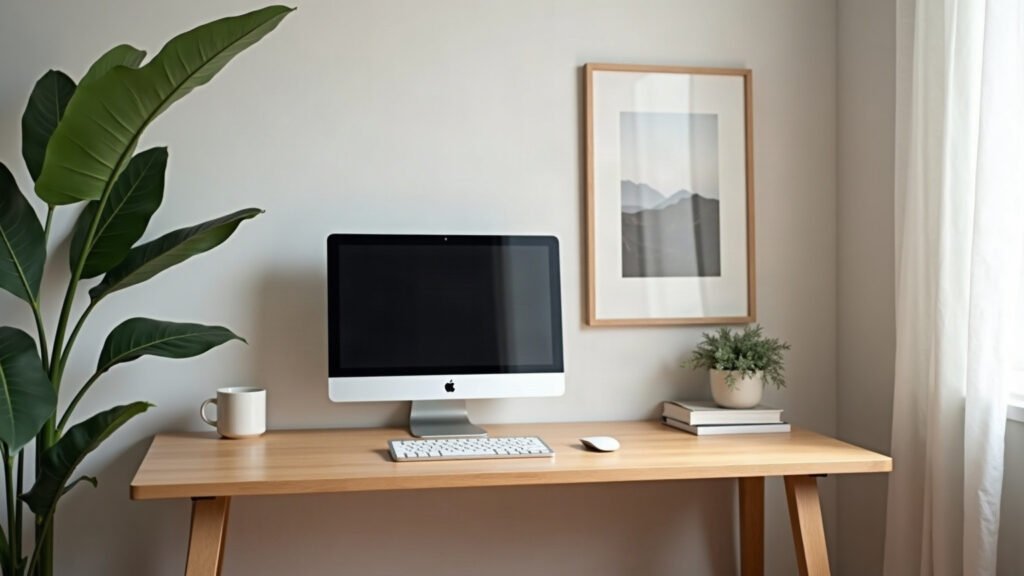
The right piece of art behind your desk should span between 60% and 75% of the visible wall space above your monitor, not the entire width of the wall. Most people measure from corner to corner of the room, buy a standard 40×50 cm frame, and hang it at standing eye level. The result looks like a postage stamp floating in dead space, cut off at the bottom by a monitor mount.
The Webcam Frame Changes the Math
A home office wall serves two distinct purposes. It sits in your peripheral vision while you work, and it acts as your backdrop on video calls. A standard wide-angle webcam lens with a 78-degree field of view captures a much narrower slice of your room than your eyes do when standing in the doorway.
If you center your art on the full wall, your webcam will often catch only one edge of the frame. That makes your video feed look off-balance. Instead, sit in your desk chair, open your webcam preview, and mark the boundaries of your camera frame with blue painters tape. That taped rectangle is your real canvas.
The art should fill the middle third of that camera view. It gives your backdrop visual structure without competing with your head for attention.
Calculate Your Target Dimensions
To find the correct size for a single print or a split panel set, grab a tape measure and use these three steps.
- Measure your total desk width. If you use a single 120 cm (48-inch) desk, your art should span 72 cm to 90 cm across. If you use a dual-monitor setup that spans 140 cm across, look for an artwork width between 84 cm and 105 cm.
- Measure vertical clearance. Raise your monitors or sit-stand desk to their highest regular working position. Measure from the top edge of your screen to the ceiling or picture rail. Subtract 25 cm to leave breathing room above the screen and below the ceiling.
- Choose single or multi-panel. A single large horizontal print creates a clean focal line. A triptych of three matching vertical prints lets you cover wider desk setups without needing custom-sized glass.
Pick the Right Material for Screen Glare
Lighting in a workspace is different from lighting in a living room. You likely have a desk lamp, a monitor light bar, or an overhead fixture reflecting directly off the rear wall. Standard glass frames turn into mirrors, reflecting your monitor light back into your eyes and washing out the image on camera.
| Material | Surface Finish | Glare Level | Best Used For |
|---|---|---|---|
| Matte Art Paper (189 g/m²) | Smooth, non-reflective | Zero | Rooms with bright monitor light bars and windows |
| Stretched Canvas | Textured matte weave | Very low | Large single pieces where glass weight is a problem |
| Framed Acrylic Glass | Glossy smooth | High | Walls with indirect, diffuse lighting only |
| Direct Foam Board | Semi-matte | Low | Temporary or lightweight rental setups |
For most workspaces, heavyweight matte paper or wrapped canvas performs best. A 189 g/m² matte poster absorbs direct desk lighting and maintains deep contrast without distracting hot spots.
Match Your Art to Your Workspace Palette
A common mistake is picking an artwork in isolation. When you sit at your desk, your wall art, your desk surface, and your accessories form a single visual field. They need a shared visual anchor.
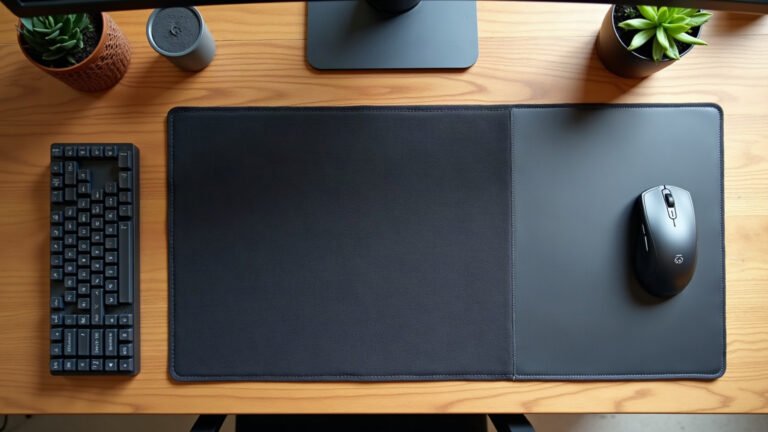
Look down at your desk. Pick the dominant neutral (like walnut wood, matte black, or light birch) and one accent tone from your setup. If you run a dark setup with an understated desk mat, choosing wall art with deep contrast and restrained line work keeps the space feeling unified. The artwork does not need to match your accessories exactly. It simply needs to share the same color temperature: cool grays and blues with black gear, or warm terracottas and ochres with wood and brass.
High-Contrast Graphic Prints
Bold typography, architectural blueprints, or high-contrast monochrome illustrations work well in compact rooms. They read clearly on low-resolution webcams and provide clean geometry behind your head.
Muted Landscapes and Abstract Textures
If you spend eight to ten hours a day facing this wall, high-saturation neon art can feel visually exhausting by mid-afternoon. Soft gradients, topographical maps, and low-contrast Japanese woodblock prints provide depth without demanding constant visual attention.
Hanging Height: The 20-Centimeter Rule
Standard gallery hanging guidelines say the center of a piece should sit 145 cm (57 inches) from the floor. Ignore this rule for a desk setup. If you hang art at standard standing height behind a seated desk, your monitors will block the lower third of the artwork.
Instead, anchor the bottom edge of the frame relative to your desk equipment:
- Hang the bottom edge 20 cm to 25 cm (8 to 10 inches) above the top of your monitor.
- If you use a sit-stand desk, set the desk to your standing height first. Ensure the bottom edge clears the monitors by at least 10 cm when fully extended.
- When seated, the art will sit slightly higher in your field of view, which actually helps draw the eyes up and away from the screen during breaks.
What to Expect When Ordering Made-to-Order Prints
Generic mass-market posters from big retail chains are printed on thin 120 g/m² paper that ripples inside the frame as humidity changes. Made-to-order art prints take slightly longer to arrive because each piece is printed, trimmed, and inspected individually.
Production takes 2 to 5 business days, extending up to 10 business days during peak holiday periods. Shipping is free across the entire United States on every order, with flat-rate international delivery starting at $7.95 (or free worldwide once your cart passes $99). You do not need to worry about shipping damage either: if your print arrives damaged, misprinted, or bent in transit, we send a free replacement or issue a full refund within 30 days of delivery with just a photo of the issue.
Your Next Step
Do not browse for prints yet. Take two minutes with a tape measure right now. Measure your desk width, calculate 70% of that number, and note your maximum monitor height. Once you have those two numbers on a sticky note, you know the exact dimensions you need before you spend a dollar.
Specifications come from our suppliers’ published data. Where we link to gear we do not make, those links may earn us a commission at no extra cost to you.

Leave a Reply